




Bronchoscopy Simulation: What Should Training Systems Measure?
 September 23, 2026
 228


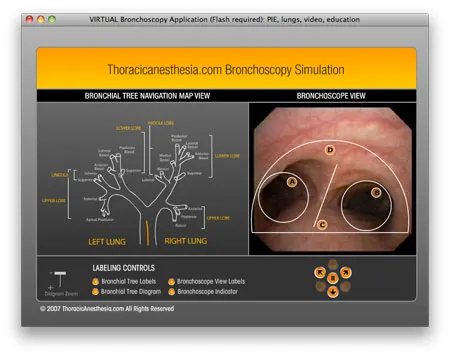
An AI training simulator for bronchoscopy should be evaluated by more than visual realism or the presence of an AI label. A useful system needs a defined progression of training scenarios, a physical platform that supports realistic instrument handling, a repeatable assessment process, and records that let educators review performance over time. For hospitals and clinical training centers, the practical question is not simply whether a simulator can reproduce an airway. It is whether the system can connect scenario-based practice with observable procedural performance and a training record that supports the next supervised learning step.
Simulation Realism Is the Starting Point, Not the End Point
Clinical simulation begins with a believable practice environment. In bronchoscopy, that means the trainee needs to navigate an anatomical pathway, manipulate a scope-like instrument, coordinate visual information with hand movement, and repeat the same task often enough to build procedural familiarity.
UE Medical’s Bronchoscope Simulation AI Plus combines a soft-silicone anatomical training platform with both nasal and oral approaches. The current product information also describes a control handle designed to reproduce the handling characteristics of EBUS bronchoscopes and a range of diagnostic and therapeutic instruments. Those elements matter because AI simulation training is still physical skills training: software assessment has value only if the trainee is practicing a relevant procedural movement in a structured environment.
A buyer should therefore separate two questions. First, does the physical simulator reproduce the type of manipulation the training program needs? Second, does the digital system capture enough information to make repeated practice measurable?
Scenario Coverage Should Follow a Progression of Skills
An effective ai simulation for training should not treat every exercise as the same difficulty level. A skills program needs a progression from orientation and basic navigation toward more demanding diagnostic or therapeutic tasks.
The Bronchoscope Simulation AI Plus currently lists five selectable modes:
- Basic Exploration — suited to initial orientation and fundamental scope navigation.
- Basic Diagnosis — adds a diagnostic task layer after basic navigation is established.
- Advanced Diagnosis — increases the complexity of the diagnostic training scenario.
- Therapeutic Procedures — extends the training environment into procedure-oriented tasks.
- Personalized Training — provides a separate pathway for targeted practice.
The important procurement point is not the number “five” by itself. What matters is whether the modes correspond to the institution’s actual curriculum. A training center should map each simulator mode to a defined learning objective, expected task, review method and progression rule.
What Should an AI Training Simulator Actually Measure?
This is the central question behind ai training simulations. If the simulator simply displays an anatomy model, it is a practice device. Once AI assessment is introduced, the system needs to turn procedural activity into information that can be reviewed consistently.
The verified product information for Bronchoscope Simulation AI Plus states that, based on PCCM assessment criteria, AI automatically evaluates, records and analyzes procedural performance. It also states that historical training records can be reviewed to analyze performance trends and optimize future training plans.
That supports three distinct layers of value:
- Evaluation: the training attempt produces an assessment result rather than disappearing once the session ends.
- Recording: the result can be retained as part of a training history.
- Analysis: repeated records can be compared to identify performance trends.
For procurement, the buyer should ask to see exactly which fields, scores or procedural events are displayed in the current system rather than assuming that every conceivable metric is recorded. The useful question is evidence-based: what does the system actually evaluate, what does it store, and how can educators review that information after repeated sessions?
Why Historical Training Records Matter More Than a One-Time Score
A single score shows one attempt. A training history can show whether performance is changing over repeated practice. That is a more useful concept for medical training AI because clinical skills education normally depends on repetition, review and progressive challenge rather than one isolated session.
The value chain is straightforward:
Repeated simulation → recorded assessment → comparison over time → educator review → next training focus.
If a trainee repeatedly completes basic exploration but struggles when moving into a more advanced scenario, the training team can use the recorded history as one input when deciding whether to repeat foundational tasks or change the next supervised exercise. The AI system does not need to make the educational decision independently; its value is that it gives the training team structured information instead of relying only on memory or informal observation.
Physical Interaction Still Matters in AI Simulation Training
The phrase ai training simulator can make the software sound like the main product, but bronchoscopy training remains a combination of visual interpretation and physical control. The trainee has to manipulate the scope, maintain orientation, move through an anatomical pathway and coordinate instrument handling with the view on screen.
That is why the physical training platform should be evaluated alongside the AI layer. UE Medical’s system uses soft silicone with anatomically realistic textures and supports both nasal and oral training approaches. Its current product information also describes height adjustment for different operators and a realistic control handle. These are not decorative features; they determine whether the trainee can practice the movements that the assessment system is intended to evaluate.
For buyers comparing bronchoscopy simulation training systems, the more useful evaluation is therefore “physical task + digital assessment,” not “AI software” in isolation.
How Should a Training Team Review a Simulator Demonstration?
| Demo Area | What to Observe | Why It Matters |
|---|---|---|
| Scenario progression | How basic, diagnostic, advanced, therapeutic and personalized modes differ | Shows whether the system can support a staged curriculum rather than one repeated task |
| Anatomical platform | Nasal/oral access, physical realism and positioning | Affects the quality of hands-on procedural practice |
| Instrument handling | How the control handle responds during navigation and task execution | Connects physical skill practice with the simulated procedure |
| AI assessment | Which procedural results the system evaluates and how results are displayed | Defines what “AI-assisted” assessment actually means in the current product |
| Historical records | How prior sessions are stored and reviewed | Supports comparison of repeated training attempts |
| Instructor review | How educators can use assessment output during debriefing | Keeps recorded data connected to a supervised training program |
| Workstation configuration | Displays, touch interaction, accessory storage and room fit | Affects deployment in a simulation lab or hospital education center |
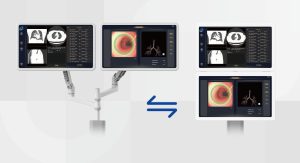
UE Medical’s product page also lists dual 23-inch Full HD displays with 10-point multi-touch capability and integrated accessory storage. Those features are relevant when the simulator is evaluated as a complete workstation rather than just a software module.
AI Assessment Should Support Supervised Training, Not Replace It
A simulator can record and analyze procedural performance, but the institution still needs to define what the results mean inside its own training program. An AI-generated assessment should not be treated as an automatic credentialing decision or as proof that a trainee is ready for unsupervised clinical practice.
The safe educational model is narrower and more useful: the system provides structured practice and structured records; educators interpret the results within the curriculum, decide when to repeat or advance training, and apply the institution’s own competency requirements.
This boundary is particularly important when ai simulation training is introduced into hospital education programs. The technology can improve the consistency of training information without replacing faculty oversight or local clinical governance.
What Should Be Included in an AI Simulation RFQ?
A strong RFQ should describe the training program before asking suppliers to recommend a configuration. Useful inputs include:
- Target trainees: residents, fellows, respiratory teams or other defined learner groups.
- Training objectives: exploration, diagnostic practice, advanced diagnosis, therapeutic procedures or another structured curriculum need.
- Required simulation routes: whether nasal and/or oral approaches are needed.
- Assessment requirements: what educators need the system to evaluate, record and review.
- Historical-record workflow: how repeated sessions should be reviewed by the training team.
- Workstation setup: display, touch interaction, physical footprint and accessory management.
- Demonstration criteria: which scenarios and assessment outputs should be shown before purchase approval.
Hospitals and training centers can review UE Medical’s broader pulmonary solutions to understand the clinical product context around bronchoscopy, then evaluate the Bronchoscope Simulation AI Plus as a dedicated training system. Once curriculum, scenario and assessment requirements are defined, the contact page can be used to submit a structured project inquiry.
-
 How Much Does a Video Laryngoscope Cost? Key Price Factors for Hospital BuyersSeptember 28, 2026
-
How AI Can Support Structured Bronchoscopy Training for CliniciansSeptember 23, 2026
-
How to Compare Single-Use Bronchoscope Configurations for Hospital ProcurementSeptember 18, 2026
-
Which Fiberoptic Bronchoscope Specifications Should Buyers Confirm Before an RFQ?September 10, 2026


 Room 3301, Sunon Central Business Building,
No. 200 Citizen Street, Shangcheng District, Hangzhou, Zhejiang, 310020, China
 +86 755 8977-4077