




Endoscope vs Bronchoscope: Which One Fits the Clinical Project?
 August 21, 2026
 723


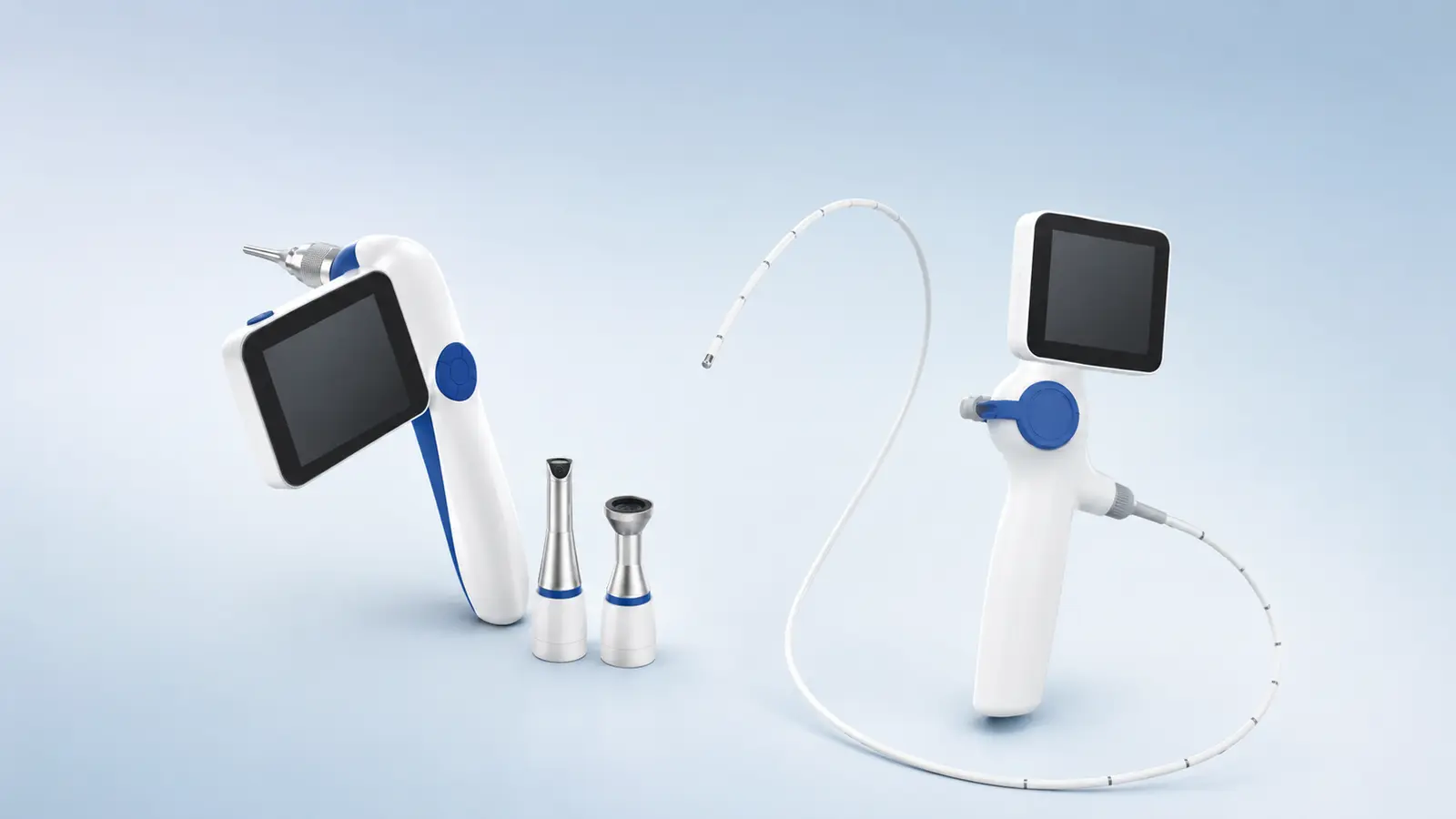
Direct Answer: An endoscope is a broad device category for viewing internal anatomy, while a bronchoscope is a specialized endoscope for the trachea and bronchial tree. Procurement teams should choose by target anatomy, procedure, insertion route, channel function, device lifecycle, and display workflow. An ENT endoscope and a bronchoscope may share video technology, but they are not interchangeable by default.
The commercial risk in an endoscope vs bronchoscope comparison is not that the names sound similar. The risk is that a project starts with a general category word and receives quotations for devices designed around different anatomy and clinical tasks. A video otolaryngoscope for ear, nasal, and throat examination can offer a compact visual platform, while a bronchoscope is configured for lower-airway navigation and pulmonary procedures. Comparing either one only by image quality or price produces a false equivalence.
For B2B buyers, the correct question is therefore not “Which device is better?” It is “Which device is appropriate for the defined department, anatomy, procedure, and operating model?” The answer should be traceable from the clinical requirement to the offered model and then to the documentation, accessories, and service included in the quotation.
What is the practical difference between an endoscope and a bronchoscope?
Endoscope is an umbrella term. It includes devices designed for different parts of the body and different specialties. Within UE Medical’s endoscope product category, buyers can find pulmonary and ENT-oriented equipment rather than one universal instrument. The category name alone does not define route, dimensions, articulation, working channel, or intended procedure.
Bronchoscope refers to an endoscope intended for examination or treatment within the tracheobronchial system. Bronchoscope selection therefore places particular attention on insertion profile, distal control, working-channel or suction requirements, image workflow, and the department’s infection-control pathway. Pediatric use, bedside ICU use, diagnostic bronchoscopy, and intervention support can require different configurations.
A video otolaryngoscope occupies another branch of the endoscope category. UE Medical describes its Video Otorhinolaryngoscope as a platform for examination and diagnosis of the ear canal, nasal cavity, and throat, with interchangeable imaging tubes and external display support. Those characteristics address an ENT workflow; they do not turn the device into a bronchoscope.

Which anatomy and procedure should drive the choice?
The target anatomy should be written at the top of the technical requirement. An ENT clinic may need rapid examination of the ear, nose, and throat, convenient changeover between imaging tubes, and a compact display arrangement. A pulmonary or ICU team may need access through the airway, controlled distal navigation, suction or sampling capability, and a scope range that covers defined patient groups.
Do not use the word “diagnostic” as the only application statement. Both devices may be used for diagnostic work, but in different anatomical regions and under different clinical protocols. State the body region, route, procedure type, intended users, and use environment. If therapeutic or channel-based functions are expected, list them explicitly.
Buyers should also separate primary use from occasional use. A department should not select a compromised configuration for its daily workload merely because another department might borrow the equipment occasionally. If a shared platform is planned, each department’s required scope, display, accessories, reprocessing pathway, and storage arrangement should be evaluated as a complete package.
How do design and channel requirements change the procurement decision?

The instrument’s physical design follows its clinical purpose. An ENT video platform may use interchangeable examination tubes or sheaths for several upper-airway and otological views. A flexible bronchoscope relies on a steerable insertion section that must navigate the tracheobronchial tree. These are different handling and compatibility questions, even when both systems include a camera and display.
Working-channel requirements are especially important in bronchoscope procurement. The team should define whether it needs suction, sampling, or another supported function; confirm channel dimensions; and review which instruments or connectors are compatible with the offered model. A channel that is adequate for one task may be restrictive for another. At the same time, a larger channel may be associated with a larger insertion profile, so the decision must be made across the full scope range.
UE Medical’s Single-use Bronchoscope page describes multiple diameter options, portable display choices, and sterile disposable packaging. A buyer should request the exact option matrix rather than assuming that every diameter has the same channel, articulation, or display compatibility. The quoted model code must remain visible through evaluation, ordering, and incoming inspection.
| Procurement criterion | ENT endoscope route | Bronchoscope route |
| Primary anatomical focus | Ear canal, nasal cavity, and throat examination | Trachea and bronchial tree |
| Core design question | Imaging-tube or sheath selection for the planned ENT examination | Insertion profile, distal control, and navigation for the airway |
| Channel decision | Confirm whether the proposed examination configuration requires a channel | Confirm suction, sampling, or supported instrument need and channel size |
| Display workflow | Compact examination display and any external-screen connection | Portable, bedside, workstation, or procedure-room display arrangement |
| Lifecycle question | Tube or sheath handling, cleaning, storage, and replacement | Reusable reprocessing and repair, or single-use inventory and disposal |
| Key acceptance evidence | Correct tube set, image function, display, and ENT workflow fit | Correct diameter/channel option, articulation, accessories, and airway workflow fit |
Why does the infection-control model affect more than price?
The reusable or single-use decision changes staffing, turnaround, inventory, and service requirements. A reusable system needs an approved cleaning and disinfection process, trained personnel, inspection, storage, and a plan for repair or downtime. A single-use bronchoscope requires sterile-pack inventory, expiry control, compatible displays, waste handling, and supply continuity.
The correct comparison is the cost of maintaining readiness for the required procedure volume. A reusable scope with insufficient turnaround capacity can create scheduling pressure. A single-use scope without a reliable replenishment plan can create stock risk. Buyers should model peak demand, after-hours availability, emergency reserve, and the number of display units needed, rather than comparing only the purchase price of one scope.
The destination market and hospital policy also affect the evidence required. Ask for the current instructions for use, model-specific regulatory documentation applicable to the market, packaging and shelf-life information where relevant, reprocessing instructions for reusable components, and disposal guidance for single-use products. A certificate for one device family should not be assumed to cover every model or accessory.
How should display and system compatibility be compared?
Display compatibility is part of the device configuration, not a secondary convenience. Confirm whether the proposed scope has an integrated display, uses a portable monitor, connects to an image processor, or supports an external screen. Then identify every cable, adapter, dock, processor, and mounting item required for the planned setup.
An ENT clinic may value fast changeover and a compact examination station. A bronchoscopy project may need a portable bedside arrangement or integration with a procedure-room workstation. The site, power access, storage, cleaning boundary, and movement between rooms all influence the correct configuration. A quotation that excludes the necessary display hardware cannot be compared directly with a complete system.
For pulmonary projects, the pulmonary solutions overview can help the buyer identify the broader equipment context. For ENT projects, the ENT solutions overview provides the more relevant route. These links are useful for defining the product family, but the final purchase specification should still list the exact device, scope, display, accessories, and intended workflow.
What evidence makes two quotations genuinely comparable?
Ask each bidder to answer the same structured requirement sheet. The response should include model identity, intended application, insertion dimensions, working length, articulation, channel details, display arrangement, included accessories, reusable or single-use status, packaging, documentation, training, service boundary, and exclusions. Use “comply,” “deviation,” and “not offered” fields so missing information cannot be mistaken for compliance.
Request a configuration diagram when several components are needed. The diagram should show the scope, handle, display or processor, cables, adapters, storage or charging items, and any procedure-specific accessories. This is particularly valuable when one supplier quotes a complete platform and another quotes only the handheld instrument.
Sample testing should use the exact proposed configuration. Record model codes, diameters, channel sizes, display hardware, and accessories. If the final quotation changes any of these elements, the buyer should decide whether a new review is required. Without this change-control step, a successful sample evaluation may be wrongly applied to a different delivered system.
Representative Scenario — Not a Claimed Customer Case
Business Background: A distributor prepares one tender response for a regional hospital that is expanding both an ENT outpatient room and an ICU bronchoscopy service.
Problem: The hospital’s initial equipment list contains one line for “portable video endoscope,” so the distributor receives offers for an ENT examination device, a single-use bronchoscope, and a reusable flexible scope.
Cause: The tender identifies video visualization and portability but does not define anatomical target, procedure, channel function, lifecycle, or display location.
Solution: The hospital separates the requirement into an ENT examination platform and an ICU bronchoscope pathway. Each line receives its own anatomy, scope configuration, channel, display, infection-control, accessory, and acceptance requirements.
Buyer Decision Value: The revised tender prevents unlike devices from competing on one price line. The buyer can evaluate clinical fit first and commercial differences second.
Which option should the buyer select?
Select an ENT endoscope route when the defined project centers on examination and diagnosis of the ear canal, nasal cavity, or throat and the offered imaging-tube configuration fits that workflow. Select a bronchoscope route when the project centers on the trachea and bronchial tree and requires the insertion, control, channel, and infection-control characteristics of bronchoscopy.
If the request spans both areas, do not force one device name to cover the complete requirement. Build separate configuration lines or ask the supplier to show how distinct scopes connect to a shared platform. Shared displays or processors may create operational value, but only when compatibility is confirmed and each clinical task retains the correct scope.
To obtain a model-specific response, provide the target anatomy, department, procedure list, patient range, channel functions, display preference, reusable or single-use pathway, destination market, quantity, and required documents through the UE Medical contact page. A detailed inquiry makes the technical and commercial boundaries visible before price comparison begins.
Frequently Asked Questions
Is every bronchoscope an endoscope?
Yes, a bronchoscope belongs to the broader endoscope category. However, not every endoscope is a bronchoscope. The term endoscope also covers devices designed for ENT, gastrointestinal, thoracic, and other anatomical applications.
Can an ENT video endoscope replace a bronchoscope?
Not by default. ENT and bronchoscopy devices are designed around different anatomical targets and workflows. Replacement is only appropriate when the exact model’s intended use, dimensions, channel function, control, and documentation support the required procedure.
Why should the working channel be specified?
The working channel determines whether the offered scope can support required functions such as suction, sampling, or compatible instruments. Channel needs must be balanced with the insertion profile and intended patient range.
Is a single-use bronchoscope always less expensive?
No. The answer depends on procedure volume, reusable reprocessing cost, repair and downtime, display investment, single-use inventory, storage, expiry, waste handling, and supply continuity. Compare the complete readiness model.
Can two scopes share the same monitor?
Possibly, but compatibility should be confirmed for the exact scope and monitor or processor combination. Buyers should also verify cables, software or image-output requirements, mounting, cleaning boundaries, and simultaneous departmental demand.
What should be tested before purchase?
Test the exact quoted configuration for image stability, handling, articulation where applicable, channel function, connection security, display visibility, accessory fit, setup, and the relevant cleaning or single-use workflow. Record model codes during the test.
What should an endoscope or bronchoscope inquiry include?
Include anatomy, department, procedure, route, patient range, insertion and channel requirements, display arrangement, lifecycle preference, quantity, destination market, documentation, training, service, and acceptance criteria.
-
 Bronchoscopy Simulation: What Should Training Systems Measure?September 23, 2026
-
How Much Does a Video Laryngoscope Cost? Key Price Factors for Hospital BuyersSeptember 28, 2026
-
How AI Can Support Structured Bronchoscopy Training for CliniciansSeptember 23, 2026
-
How to Compare Single-Use Bronchoscope Configurations for Hospital ProcurementSeptember 18, 2026


 Room 3301, Sunon Central Business Building,
No. 200 Citizen Street, Shangcheng District, Hangzhou, Zhejiang, 310020, China
 +86 755 8977-4077