




How to Intubate a Patient: What a Clinical Training Video Should Show
 August 13, 2026
 672


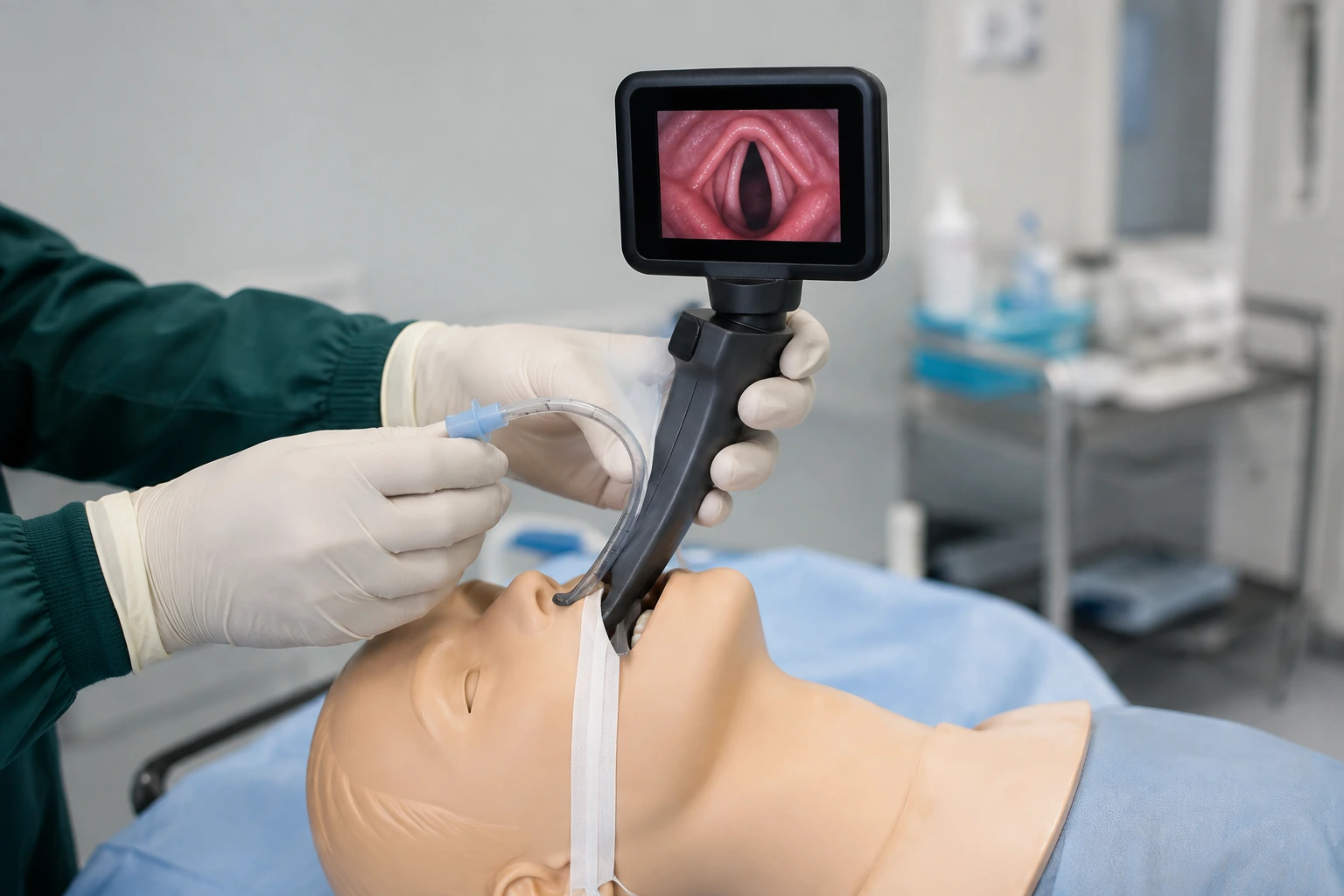
Who should use an intubation training video?
Its appropriate audience includes anesthesiology, emergency medicine and critical-care clinicians; supervised trainees; airway-course faculty; simulation-center teams; and biomedical or procurement personnel evaluating visualization equipment. It should not be treated as authorization for an untrained person to perform intubation.
For a hospital buyer, the video also serves a second purpose: it reveals whether a proposed device fits the institution’s real workflow. A clear image is valuable, but readiness also depends on blade range, tube path, screen positioning, cleaning or single-use workflow, accessories, charging, storage and compatibility with the hospital’s difficult-airway plan. UE Medical’s airway management portfolio can be reviewed as a system rather than as an isolated screen-and-handle purchase.
What must the video show before an intubation attempt begins?
A clinically responsible video starts before device insertion. The opening sequence should show that the clinician has assessed the airway and physiological risk, identified the planned technique, assigned team roles, completed equipment checks and prepared alternatives. The exact technique must follow the patient’s condition, clinician competence, local policy and current professional guidance.
Pre-attempt training-video review checklist
| Video element | What the reviewer should see | Risk if omitted |
| Assessment and plan | Airway and physiological risks, primary plan and escalation criteria are acknowledged. | The learner may assume one method fits every patient. |
| Team preparation | Roles, communication and help-escalation points are explicit. | Tasks may be duplicated or missed during deterioration. |
| Oxygenation strategy | Preoxygenation and oxygenation continuity are treated as priorities. | View acquisition may be emphasized while oxygen reserve is ignored. |
| Equipment check | Display, camera, blade, tube, cuff, suction, confirmation equipment and rescue devices are checked. | A correct plan can fail because equipment is unavailable or incompatible. |
| Attempt limits | The video identifies when to stop, reoxygenate, change approach or call for help. | Repeated attempts increase delay and airway trauma. |
What should viewers learn from the visualization sequence?
The educational value lies in linking what appears on the screen to controlled device handling. A good recording shows external orientation and the video image together, avoids suggesting that force compensates for a poor path, and distinguishes obtaining a laryngeal view from successfully advancing the tube. The operator should respond to difficulty by reassessing alignment, device choice and the planned adjunct rather than continuing blindly.
This is where procurement decisions affect training. Different blade geometries and tube-delivery paths can demand different psychomotor skills. A department should evaluate the full system with its commonly used tubes and adjuncts in simulation before broad deployment. A classic video laryngoscope may support familiar workflows, while a one-time-use visual laryngoscope changes consumable stocking and post-use handling. The decision should follow the intended patient groups, clinical environment and training plan—not the camera specification alone.
How should tube placement and completion be represented?
Passing a tube through the visualized glottic opening is not the end of the safety sequence. The video should show that placement is confirmed with the institution’s objective confirmation method and assessed alongside the clinical context. It should also include tube securement, ventilation review, documentation and a plan for ongoing airway management. A recording that ends immediately after tube passage creates a misleading training endpoint.
Five recurring experience-based mistakes deserve particular attention:
- Choosing by image resolution alone: image quality matters, but blade availability, screen position, tube delivery and system readiness often decide usability.
- Practising on only one easy scenario: teams need supervised simulation across the patient groups and environments within their scope.
- Ignoring device-to-tube compatibility: a good view does not guarantee a workable tube path.
- Omitting failure transitions: training should define when the primary attempt ends and the rescue pathway begins.
- Separating purchase from implementation: accessories, consumables, cleaning, charging, storage and competency assessment create hidden deployment costs.
How can a hospital evaluate an intubation video and device together?
Use a multidisciplinary review involving clinical educators, airway leads, infection-prevention staff, biomedical engineering and procurement. Ask the supplier to demonstrate the proposed configuration, then test the same configuration in simulation. Do not infer model compatibility or intended use from a generic marketing recording; verify the current instructions for use and locally applicable regulatory documentation for every component.
Hospital evaluation priorities
| Decision area | Evidence to request | Buyer question |
| Clinical fit | Intended-use statement, available configurations and supervised demonstration | Does the system cover our defined settings and patient groups? |
| Workflow fit | Setup, accessory, storage and post-use workflow | Can staff make the complete system ready without workarounds? |
| Training | Competency pathway, simulation support and refresher plan | How will users progress from orientation to supervised competence? |
| Reliability | Pre-use check, battery or power plan and service process | What happens if the primary display or device is unavailable? |
| Lifecycle cost | Reusable components, consumables, accessories and service scope | What is the cost per ready-to-use airway setup? |
Scenario: Building a video-laryngoscopy training pathway
Business Background: A hospital group plans to standardize video-assisted airway equipment across operating rooms, emergency departments and ICUs.
Problem: Buyers receive several impressive procedure videos, but the clips use different blades, tubes and supporting equipment. None shows setup, confirmation or rescue transitions.
Cause: The evaluation focuses on the best recorded laryngeal view instead of the complete clinical workflow and implementation burden.
Solution: The group creates a common simulation checklist, requests a model-specific demonstration, verifies accessories and post-use workflow, and builds supervised competency assessment around its local airway algorithm. A configurable total airway workstation can be considered when the project requires organized access to multiple visualization tools, subject to local review and configuration confirmation.

Frequently asked questions
Can someone learn to intubate a patient from a video alone?
No. Video supports orientation and reflection, but clinical competence requires formal education, supervised simulation, supervised clinical practice and assessment under applicable professional and institutional requirements.
Should an intubation video show only the laryngoscope screen?
No. Viewers need the external device position, team actions, monitoring context and screen image to understand the workflow and recognize unsafe omissions.
Does a better laryngeal view guarantee successful intubation?
No. Tube delivery, device geometry, adjunct compatibility, operator skill, patient factors and the wider airway plan remain important.
What equipment should hospitals evaluate with a video laryngoscope?
Evaluate the complete intended configuration, including blades, compatible tubes and adjuncts, display or power arrangements, suction access, storage, cleaning or disposal workflow and backup equipment.
How should a hospital compare reusable and single-use configurations?
Compare clinical fit, availability, infection-control workflow, waste, reprocessing resources, consumable supply, service requirements and total cost per ready-to-use setup.
Why must confirmation appear in the training video?
Because visualized tube passage alone is not a complete placement-verification process. The video should reinforce the institution’s objective confirmation and post-placement checks.
What information should be included in an RFQ?
State intended departments, patient groups, expected use volume, preferred reusable or single-use workflow, existing tubes and adjuncts, display needs, cleaning resources, training scope and required market documentation.
Request a configuration review
For a hospital or distributor project, provide the intended departments, patient groups, estimated procedure volume, preferred blade and consumable workflow, existing airway accessories, training requirements and destination market. UE Medical can help map those requirements to an airway visualization configuration and prepare model-specific product information for technical review. Submit the project details through the UE Medical contact page.
-
 Bronchoscopy Simulation: What Should Training Systems Measure?September 23, 2026
-
How Much Does a Video Laryngoscope Cost? Key Price Factors for Hospital BuyersSeptember 28, 2026
-
How AI Can Support Structured Bronchoscopy Training for CliniciansSeptember 23, 2026
-
How to Compare Single-Use Bronchoscope Configurations for Hospital ProcurementSeptember 18, 2026


 Room 3301, Sunon Central Business Building,
No. 200 Citizen Street, Shangcheng District, Hangzhou, Zhejiang, 310020, China
 +86 755 8977-4077